Off-Campus Student Housing in NYC: A Practical Guide

May 11, 2026 | By Elie Mansdorf
Off-Campus Student Housing in NYC: A Practical Guide
NYC student housing is a structural mismatch. Students need nine- or twelve-month leases that line up with the academic calendar. The NYC rental market runs on twelve-month leases that start whenever the last tenant leaves, with no regard for your winter break or your summer internship in D.C. Dorms solve part of this, but they’re expensive, capacity-constrained at most schools, and often unavailable past the first or second year of undergrad. After that, you’re on your own.
This guide is for students (undergrad, grad, or international) trying to figure out how off-campus housing in NYC actually works. It covers what the options genuinely look like, how to think about commute and cost, where lease flexibility comes from, and what to avoid.
The Three Real Options for Students
Strip away the listing-site noise and there are essentially three paths for a student who isn’t living in a dorm:
1. Traditional lease with roommates
You and one or more roommates sign a standard twelve-month lease on an unfurnished apartment. This is the classic “find three friends on Facebook and go hunt for a Bushwick three-bedroom” path. It can be the cheapest option per square foot. It also requires a broker fee (typically 12–15% of annual rent paid by the tenant), first and last month’s rent, a security deposit, and a US guarantor earning roughly 40x the monthly rent if you don’t meet income requirements yourself. For most students, that last part is the dealbreaker.
2. Co-living (furnished, flexible, per-room lease)
You rent a private bedroom in an already-furnished apartment and sign a lease on just your room — not the whole unit. The operator handles roommate matching, utilities, Wi-Fi, furniture, and often cleaning. Lease terms are typically flexible, ranging from month-to-month agreements up to six- or twelve-month commitments. This is structurally the best fit for a student schedule, because you can lease for a single semester, leave for summer, and come back without restarting from zero. It’s not the cheapest per square foot, but the all-in price (rent + utilities + Wi-Fi + furniture) is often competitive with a traditional lease once you do the real math.
3. Subletting someone else’s lease
Short-term, informal, usually cheaper than option one or two, but typically in a grey area legally. Many NYC leases prohibit subletting without landlord consent, and an illegal sublet means you can be evicted without notice if the primary leaseholder’s landlord finds out. Subletting from a tenant who has actual written permission to sublet is fine and often a good deal. Subletting off a random Reddit post is a gamble. Know which one you’re doing.
The Lease Flexibility Problem
The single biggest operational issue for student renters in NYC is that academic calendars don’t match lease calendars. The standard NYC lease runs twelve months. A standard academic year runs from late August or early September to mid-May. That four-month gap is where most of the pain happens:
- If you sign a twelve-month lease starting September 1, you’re paying for housing through August 31 — including summer months when you may be home, abroad, or at an internship in another city.
- If you try to sublet for the summer to recoup those costs, you need the landlord’s permission, and you need to find a qualified subletter in a competitive market.
- If you’re a graduate student on a rotation or a semester-abroad program, the mismatch gets worse. You may only need housing for five months, but the market doesn’t offer five-month leases.
Co-living is the direct structural fix for this. A three-month or six-month co-living lease means you pay for what you actually use. Roomrs, for example, offers leases starting at three months with month-to-month options after the initial term. For a student on a predictable academic calendar, that’s the difference between paying for twelve months of housing and paying for nine.
How to Think About Location: A Commute-First Approach
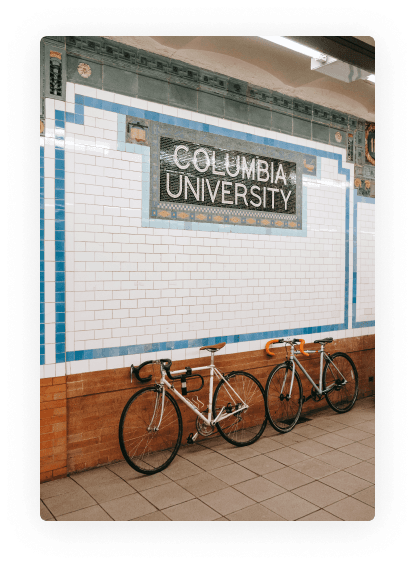
Most student housing advice starts with neighborhoods. That’s backward. Start with your campus, add the subway lines that serve it, and then figure out which neighborhoods those lines connect to within a reasonable commute. A 35-minute subway ride with no transfers beats a 20-minute walk to a subway line that requires two transfers.
A rough commute map by university:
Columbia University (Morningside Heights)
The 1 train runs straight up the west side. Living anywhere on the 1 line between 14th Street and 137th Street is realistic — the Upper West Side, Lincoln Square, Morningside Heights itself, Manhattan Valley, and Harlem all work. Some students also live in Washington Heights and commute down. Crossing to the east side (Upper East, Yorkville) requires a bus transfer and is slower than the distance suggests.
NYU (Greenwich Village / Washington Square)
NYU’s campus is distributed across the Village, so nearly every train in lower Manhattan gets you somewhere useful. East Village, Chelsea, Union Square, and the Lower East Side are all walkable or one-stop rides. Brooklyn options: Williamsburg (L train), DUMBO (F), and Park Slope (2/3).
Fordham (Rose Hill in the Bronx, Lincoln Center in Manhattan)
Rose Hill is Metro-North territory — housing options nearby (Belmont, Fordham, Bedford Park) are significantly cheaper than Manhattan but culturally distinct from a traditional college experience. For Lincoln Center, the Upper West Side is the obvious choice; 1 train access matters.
The New School / Parsons (Union Square / West Village)
Similar commute map to NYU. Union Square is a hub, so the 4/5/6, L, N/Q/R/W, and PATH all converge. This gives Parsons students more geographic flexibility than almost any other NYC student population.
Pratt (Clinton Hill, Brooklyn)
The G train is Pratt’s lifeline and the G is notoriously slow — plan commutes accordingly. Clinton Hill, Fort Greene, and Bed-Stuy are the natural choices. Williamsburg is reachable but the G connection is the bottleneck.
Hunter / John Jay / CUNY Graduate Center (Midtown East)
The 6 train and the E/M are your friends. Upper East Side, Murray Hill, Kips Bay, and Long Island City (via the 7) all work. Queens options are often the best value for CUNY students.
You can filter room rentals by neighborhood to see what’s available near each of these commute corridors.
The Cost Picture, Honestly
A realistic 2026 snapshot of monthly student housing costs in NYC, per person:
- NYU / Columbia / Fordham dorms: roughly $1,400–$2,200/month, though billed per semester, sometimes with dining plan bundles that inflate the effective cost
- Traditional apartment with roommates (per bedroom, unfurnished, outer-borough): $1,000–$1,800/month base rent, plus $150–$250/month utilities, plus one-time costs that amortize to roughly $150–$300/month over a year (broker fee, furniture, deposits)
- Co-living private bedroom (furnished, utilities included): roughly $1,200–$2,400/month all-in depending on neighborhood and apartment
- Subletting: varies wildly — a legal summer sublet in a desirable neighborhood can run 15–25% below market; an illegal sublet can be cheap but carries real risk
The honest comparison is rarely about headline rent, it’s about what’s bundled. A $1,600/month co-living room with utilities, Wi-Fi, and furniture included often costs less in total than a $1,300 room in a traditional apartment where you add $200 for utilities, $150 amortized broker fees, and a few hundred up front for a mattress and a desk. If you’re a student doing this math for the first time, build a real all-in number before comparing.
For students specifically looking at the lower end of the range, Roomrs has a guide to finding rooms under $1,000/month that’s worth a look.
International Students: The Guarantor Problem
If you’re an international student, the biggest obstacle to a traditional NYC lease isn’t finding an apartment — it’s meeting income and credit requirements that assume you have US credit history and a US-based co-signer. Most landlords require:
- An annual income of roughly 40–50x the monthly rent (a $2,000/month apartment requires $80,000–$100,000 in annual income)
- A US credit score, typically 650 or higher
- A US-based guarantor earning 80–100x the monthly rent if you don’t meet the income requirement yourself
None of this is structured for someone on an F-1 visa with no US credit history and parents who live abroad. Three practical workarounds:
- Institutional guarantor services will serve as your co-signer for a fee, typically 80–110% of one month’s rent. Accepted by most larger NYC landlords; verify before signing a fee agreement.
- Pay several months of rent upfront. Many landlords accept six or twelve months prepaid in lieu of a guarantor. Ties up cash, but removes the guarantor issue entirely.
- Co-living operators generally have accommodations for international students built into their application process — shorter leases, no guarantor requirement in many cases, and pre-furnished units that remove the “ship furniture from home” problem entirely. For international students, this is often the path of least resistance.
What to Avoid
Student housing in NYC has a predictable set of scams and pitfalls. The pattern is almost always the same: a listing that looks too good, a landlord who can’t show the apartment in person, a request to wire a deposit before you sign. A few specific red flags:
- Any listing that requires a deposit before you’ve toured the apartment, met the landlord or leasing agent, and signed a lease
- Craigslist or Facebook Marketplace listings where the owner is “overseas” and can’t show the apartment
- Prices significantly below market for the neighborhood and apartment type
- Informal room-share arrangements where you’re not on the lease and have no tenant rights if something goes wrong
- Furnished sublets where the primary tenant has not disclosed the sublet to the landlord
If you’re new to the co-living model specifically and want to understand how it differs from traditional renting, we’ve got a useful primer on co-living to check out before you start applying.
